England captain Wayne Rooney was delighted with the patience shown by his side as they caught Switzerland twice on the counter to win 2-0 and get off the mark in their UEFA EURO 2016 qualifying campaign.
Switzerland are expected to be England's closest competitors in Group E, but Danny Welbeck's double gave England an early headstart in the race to qualify. "We've put the work in, we worked on our defensive shape when we haven't got the ball and then springing from defence into attack, which you see with the goals tonight," Rooney told ITV. "We're pleased that the things we've worked on have paid off so it's a happy performance for us."
He added: "We did well as a team and we took our chances. We caught them on the break with speed and Dan got two great goals so I'm really delighted." Arsenal new boy Welbeck notched his first international goals for more than a year, first tapping home after an exquisite ball across the box from Raheem Sterling, before showing great composure and awareness to calmly slot past stranded Swiss keeper Yann Sommer in the dying moments.
The former Manchester United forward felt that his goals were ultimately just rewards for the work ethic shown by England. "I think we created a number of chances which maybe we could have done better with the final pass. Once we got the first goal I think we were in control and played a good team game today and you could see the work ethic - everyone is playing for each other and that's very important," he said.
The 23-year-old could not hide his delight after scoring his fine second goal, but was quick to praise those who worked hard to provide him with the opportunity. "Obviously we've sat back a little bit deeper and we've got the pace to get in behind them so once they went Raz (Sterling) took the ball down the wing, played it into Rickie (Lambert) and then I knew he had the ability to slide me in and thankfully he did that," he added. "My first touch was nice and it was a nice finish."
You could see the work ethic - everyone is playing for each other and that's very important.Danny Welbeck, England forward
England manager Roy Hodgson, who has endured a difficult few days following his side's uninspiring 1-0 win over Norway last week, threw his fists in the air in a show of sheer delight and, no doubt, relief when Welbeck smashed home the second goal. Since the narrow win on Wednesday, Hodgson has had to bat away constant criticism and reaffirm his belief in his players, who were mostly the same faces that failed to make it out of the group stages of this summer's 2014 FIFA World Cup Brazil™.
To see Welbeck put clear daylight between them and the Swiss in such an emphatic manner must have been doubly gratifying for the former Fulham boss, but he stuck to just congratulating his charges afterwards. "I've never really lost faith. I'm just pleased to see the boys play well. I thought that the way we approached the game from the first minute was exactly what we wanted and we got our reward for once," he said.
"I think we made hard work of it because there were so many chances to score goals before we eventually got the one that we needed but it was a good performance away from home against one of the better teams in the group and I'm pleased we won." There were some shaky moments for England, with Chelsea defender Gary Cahill forced into a last-ditch clearance late on and Hodgson was delighted that his players refused to wilt under the pressure. "I thought they played some good football in the second half. I thought in the first half we were largely in control but they got better as the game went on but luckily we didn't deteriorate too much," he added.
Despite keeping a clean sheet Hodgson also emphasised that this result is just a foundation to be built upon as he looks to turn a promising group of young players into hardened campaigners ahead of Euro 2016.
He said: "I think there are areas there that we've got to improve. But you can't expect players playing their early games, or even making their debuts, to make all the right decisions and not show some naivety from time to time because of the pressures of the game. They are areas we can work (on) and we've got a couple of years to do so."
By Fifa.com:
Nearly two months have gone by since Germany claimed their fourth world title at the 2014 FIFA World Cup Brazil™, time enough for the experts to digest the events of those memorable four weeks and assess what they saw on the field of play.
It was with that very objective that FIFA invited coaches and directors of football from the member associations of the CONCACAF and CONMEBOL zones to Panama for a two-day conference, held on 11 and 12 September. FIFA.com was there too, and over the next few days we will be sharing with you the exclusive chats that we had with some of the conference’s many luminaries.
Among them was Mexico coach Miguel Herrera, who spoke of his passion for football, his eyecatching goal celebrations and his reactions when he sees them repeated on TV afterwards. "We were the only team in the World Cup that had the Netherlands 75 minutes on their own area, they were more worried about defending than going forward to attack," Herrera said. He also told us which goal got him going the most at Brazil 2014 and discussed the spectacular World Cup enjoyed by Tri goalkeeper Guillermo Ochoa and his side’s Round-of-16 exit at the hands of the Netherlands.
Another star of the recent world finals was Costa Rica coach Jorge Luis Pinto, who revealed just how much work he put into studying each of his team’s opponents. "I always wanted to give my players optimism and desire from the beginning to the end, and that was very useful for us in Brazil," Pinto said.
As well as praising his midfield for cancelling out the threat posed by Italian wizard Andrea Pirlo in the group phase, Pinto spoke of his reaction to Michael Umana’s winning penalty against Greece in the Round of 16 and the reasons why he believes Keylor Navas has the edge over Iker Casillas at Real Madrid. We also asked him if he was surprised by Louis van Gaal’s last-minute introduction of giant goalkeeper Tim Krul in the quarter-final showdown with the Dutch. The answer to that question will soon be revealed.
Absent from Brazil 2014, Peru have embarked on a new era with Uruguayan coach Pablo Bengoechea, who has taken on the job after a spell as assistant to Sergio Markarian. Sharing his vision of the game with us, Bengoechea revealed the style of football he wants his team to play and discussed his sense of anticipation at taking on this new challenge and the prospect of facing the country of his birth.
Last but by no means least, the great Francisco Maturana reflected on Colombia’s performance, pondering the reasons for their defeat to Brazil and the impact of Radamel Falcao’s absence. As well as assessing the team’s stand-out performers and the work of coach Jose Nestor Pekerman, Pacho gave his views on James Rodriguez’s arrival at Real Madrid and whether the time was right for the young midfielder to move to Spain.
Find out what the wise men of Latin American football had to say at the Panama conference by checking out FIFA.com in the coming days. You will not be disappointed!
The Barcelona soccer club is opening an academy in Broward. The goal: Brand the club in fledgling U.S. players’ minds.
BY FERNANDO PEINADO
THE ASSOCIATED PRESS
As the U.S. appetite for soccer grows, more American kids are harboring dreams of becoming the next David Beckham or Leo Messi. Their aspirations, realistic or not, have not gone unnoticed by top international teams, which are trying to capitalize financially.
European clubs like Barcelona, Liverpool and Arsenal have long sent coaches to work at U.S. summer camps, but now some are opening year-round U.S. academies aimed at finding new talent while also expanding their fan bases and revenue opportunities in the states. Later this month, Barcelona will open FCB Escola Florida, its first permanent U.S academy, in Fort Lauderdale. Argentine Boca Juniors and English Everton are already operating in New York and Connecticut, respectively. Other teams are expected to follow.
The expansion of such programs is part of a bigger trend, as major international clubs try to grow their brands in the U.S. to battle for the hearts and pocketbooks of Americans today and in decades to come. Building an international fan base is becoming important for the top teams, which derive a large chunk of their revenue from overseas broadcasting and merchandising. Real Madrid, for instance, has looked at space for a store in Miami's Mary Brickell Village but has not signed a lease, said Fernando Perez, the shopping-and-dining district’s general manager.
“If you can engage kids when they are young, then they will stay with you for the rest of their lives,” says Simon Chadwick, a sports economist at England’s University of Coventry.
The U.S. soccer audience is reaching new heights, with this summer’s World Cup setting ratings records. NBC is paying $250 million to broadcast the English Premier League. A record crowd of 109,318 packed Michigan Stadium on Aug. 2 to see an exhibition match between Manchester United and Real Madrid. Major League Soccer is averaging more than 18,000 per game, just off its 2012 high.
When teams started opening schools around the world back in the 1990s, their early impulse was to scout and develop players. Now, their main goal is to build their brand, says Simon Kuper, the author of several books on the economics of sports.
One of the first overseas academies was launched in 1999 by Dutch Ajax in Cape Town, South Africa. The club says it produced an average of seven pro players a year. A handful of them have made it to European leagues.
Barcelona chose South Florida for its first U.S. academy and its 12th worldwide. Over 600 boys and girls attended tryouts in May, some coming from other states and countries, like Haiti, Venezuela and Canada, to vie for 384 spots. The winners will pay $3,000 annually to attend the academy, which does not include room, board or schooling. Some parents say they will move their family to South Florida if their child is picked.
Marcel Bombonato, the managing director of Kaptiva Sports, official partner of FC Barcelona in the U.S., says scouting is one of the goals. But beyond teaching soccer, the club wants to convert children into Barcelona fans.
Some 3,200 children attended seven soccer camps held this summer by Barcelona across the eastern U.S. Each day they listened to the team’sCant del Barca, and at a recent Miami camp most of the 245 children clad in Barcelona colors clapped their hands and chanted the chorus, “Barca, Barca, Barca.”
Many parents see these programs as an opportunity for their children to showcase their talents and hopefully be recruited for the team’s La Masia academy. Messi left Argentina for Spain at the age of 13 after being discovered by a Barcelona scout.
Ali Rafique brought his 6-year-old son Toby to the camp in Miami from Dallas. Toby trains more than 20 hours per week between his practices with a personal coach and the Dallas Texans under-7 team. He wants to eventually play for Barcelona.
“I am gonna work hard to make his dream come true,” said his father.
Argentinian Boca Juniors, known as one of the largest exporters of players to the leagues in Europe, opened its academy in Long Island, New York, in March. The team is still recruiting 200 boys and girls aged 4 to 23.
Mariano Berenstein, the CEO of Boca Juniors in the U.S, says that unlike other international teams, Boca Juniors is concerned with developing local talent, rather than just monetizing the brand. He said that other teams promise young children that they have a chance to play at their home-based academies and advance up to the main team. Instead, Boca Juniors wants to build an American version with the hope that the most talented players would play in MLS.
We will not make “empty promises” to players, Berenstein says.
Miami Herald staff writer Ina Paiva Cordle contributed to this report.
Once upon a time, the World Cup featured genuine tactical innovations, with far-flung countries arriving at the tournament with something the rest of the world had never previously encountered.
These days, that simply doesn't happen -- there's too much knowledge about world football in general, and tactics have become homogenised. Now, the World Cup acts as a barometer of the dominant style of the moment. Here's what World Cup 2014 featured:
Aggressive goalkeepers
Arguably the main tactical talking point from the tournament was the extremely advanced sweeper-keeper role perfected by Manuel Neuer, most obvious throughout Germany's 2-1 extra-time victory over Algeria.
Neuer continually charged out of his goal and into wide areas to make tackles -- not just interceptions, but literally outfield tackles -- as Algeria continually attempted to break in behind the German defence. This was too extreme for Joachim Low, and the fact that the sluggish Per Mertesacker was dropped for the rest of the tournament was probably a recognition that Germany were relying on Neuer too much as an eleventh outfielder. Still, Neuer continued that approach in the final, wiping out Gonzalo Higuain in the left-back zone.
The vast majority of goalkeepers weren't as aggressive as Neuer, but many were extremely quick off their line. This was a crucial part of Tim Howard's superb display against Belgium: The saves weren't spectacular, but he shut down the angle excellently, so they didn't have to be.
Manuel Neuer's collision with Gonzalo Higuain epitomised the German goalkeeper's aggressive play in the World Cup.
In the same match there was another fine example: Thibaut Courtois' superb save from Clint Dempsey after the USA's well-worked free kick. Again, it looks like a simple block, but Courtois' quick reaction and tremendous acceleration was truly remarkable. Whatever happened to goalkeepers going in goal because they weren't mobile enough to play outfield?
Neuer's approach is an exaggerated example, but it's easy to imagine young goalkeepers across Germany -- and elsewhere -- becoming inspired by his proactive style.
Three-man defences dominate
This tournament was a fantastic advert for the three-man defence. By the end of the group stage, three-man defences had played eight matches against teams playing a back four, and remained unbeaten, with only two draws, both without a goal: Costa Rica against England, and Mexico against Brazil.
Recently, three-man defences have often been used for attacking reasons, but throughout this tournament, the three-man backlines were secure defensively. Costa Rica and Mexico played the system throughout, while Chile and the Netherlands switched between a back three and a back four according to the nature of the opposition.
It's highly unfortunate these sides found themselves on the same route to the final -- the Dutch beat Chile in the final group game, then eliminated Mexico and Costa Rica. All four sides can consider themselves unfortunate to be eliminated: the Netherlands, Chile and Costa Rica all lost on penalties, while Mexico trailed in the entire competition for less than two minutes, victims of a late turnaround against the Dutch.
Three-man defences aren't entirely uncommon in modern football, but it felt like opponents were entirely unprepared for the challenge. The best example was on the second day, with Mexico's 1-0 victory over Cameroon -- it should have been more a more resounding win, but for some poor offside decisions. Mexico wing-backs Miguel Layun and Paul Aguilar continually pushed back the Cameroon wingers, who were playing in a 4-3-3 system and therefore should have been supporting the central striker. Instead, they tracked back Layun and Aguilar all the way, to the point where Cameroon were effectively playing a back six, and unable to break forward.
That was one small example, but it summarised the problems with playing against wing-backs -- the most natural way to counter them is to play wing-backs yourself.
Classic strikers continue to struggle
It was only natural that Thomas Muller, that most unusual of forwards, was the obvious pick up front in everyone's team of the tournament. This wasn't a World Cup for strikers.
Muller played up front in the group stage, netting a hat trick against Portugal in Germany's first game, but he actually spent that match continually sprinting laterally to the flanks, making space for others to exploit. Of course, Muller eventually moved right to make way for Miroslav Klose, which helped the balance of the German side. But Klose wasn't a major factor in Germany's knockout stage success, and while he surpassed Ronaldo's all-time World Cup goal-scoring record, he still feels like a throwback -- if Neuer is the ultra-modern goalkeeper, Klose is the ultimate old-school striker.
Few other strikers shone. Gonzalo Higuain of Argentina had a poor tournament apart from one brilliant snapshot against Belgium, and wasted the final's best chance. The Netherlands' Robin van Persie was quiet by his usual standards, his superb header against Spain his most significant contribution. Brazil's Fred was terrible throughout.
Thomas Muller was among the tournament's best attacking players, albeit often from a wide position.
Elsewhere, strikers were often exciting sides' weak link -- Colombia's Teo Gutierrez disappointed, as did Mexico's Oribe Peralta. There were flashes of brilliance from the likes of Joel Campbell, Enner Valencia, Josip Drmic, Georgios Samaras, Islam Slimani and Luis Suarez -- but only Campbell reached the quarterfinals, where he had his quietest game.
The tournament's best six attackers were Muller, James Rodriguez, Arjen Robben, Leo Messi, Neymar and Alexis Sanchez. None were classic strikers, and while there's an argument you still need a striker to bring the best out of these mobile, versatile attackers, these days they're rarely the star attraction.
Lots of crossing
Successful sides rarely base their approach entirely around crossing, but it remains a dangerous weapon when used sporadically, at the right moments. Throughout the competition, various sides had success by getting the ball wide and putting it into the mixer.
There was Italy's fine victory over England, where Antonio Candreva and Matteo Darmian continually combined to overload Leighton Baines down the right, or right-back Serge Aurier's double assist for two quick goals in the Ivory Coast's comeback against Japan. Left wing-back Daley Blind created two goals for the Dutch in their thrashing of Spain, while U.S. got most joy from their right, when Fabian Johnson charged forward from deep -- he was one of the competition's best full-backs.
There were also some excellent crosses from Algerian left-back Faouzi Ghoulam, plus both Costa Rican wing-backs Junior Diaz and Cristian Gamboa, and the energetic Greek pairing of Jose Holebas and Vasilis Torosidis.
Whereas tactical battles in 2010 were about the midfield numbers game, in this tournament the teams looked to shift the ball wide. Games were often about full-backs breaking forward to create overloads, but then leaving themselves exposed to the counter-attack. Switzerland's 5-2 defeat to France was a good example -- Ricardo Rodriguez and Stephan Lichtsteiner continually attacked, but then Mathieu Valbuena and Karim Benzema charged past them into space.
Even the final was about battles out wide -- both teams worked their right wing, with Philipp Lahm sprinting forward to combine with Muller, and Messi drawing wide to help Ezequiel Lavezzi. The tournament's winning goal came from the other flank, Mario Gotze slamming in Andre Schurrle's ball from the left, but it was fitting that the winner came from a cross.
It is no secret that FIFA has been mired in governance and corruption
scandals for many years. The challenges keep piling up as the man at
the helm, Sepp Blatter, clings to power indefinitely, illustrating the
extent to which some international sports organizations lag behind many
countries in terms of democratic governance standards. As I argued in
2010 during the World Cup held in South Africa, FIFA is a multibillion
dollar organization that profits handsomely at the expense of development of host countries.
Fortunately, the absence of governance in FIFA itself has not fatally
damaged the fun and beauty of the game. Most of the World Cup games in
Brazil have been exciting and raised enormous interest and passions
around the world, even in unexpected places like the United States,
where its first round game against Germany drew more online viewers than
the NBA finals.
Yet skeptics remind us that, ultimately, it is all about money. And,
yes, plenty— including FIFA’s lack of governance and its head’s
perpetuation of his own power—may be about money. But is money the main
driver of soccer success for a national team in the World Cup?
Money Doesn’t Always Talk
A number of analysts and organizations making predictions about the
World Cup say that it is. In fact one prominent financial firm, ING,
utilized the monetary market value of
the national team (aggregating the market value of each player) to
predict that the World Cup winner would be Spain, the highest valued
national team at close to $1 billion!
Or perhaps money matters in other ways, such as how large the
country’s economy is, how well paid the team manager is, or whether the
national team was able to recruit a foreign manager. We also hear that
oil riches might have bought the right to host the World Cup, as has
been said of Qatar, or can buy a top European football club. But do national teams from resource-rich countries perform better at the World Cup?
Beyond money matters, we read about population size as a critical
determinant (much larger potential pool of soccer players), and also
about the "luck of the draw." When the lottery
took place to assign the 32 World Cup teams to the eight groups for the
first stage, many bemoaned that their national teams had been assigned
to a "group of death," while others were placed with weaker contenders
and, thus, seemingly easy groups.
Analyzing the statistical evidence provides some surprising insights.
It turns out that in looking at what differentiates success from
failure in advancing to the second stage (round of 16) of this year’s
World Cup, money does not seem to make a difference. Neither the
monetary value of a team, nor the salary of the team’s manager (nor
whether the manager is a national or foreigner) matter statistically.
Controlling for other factors, the size of a country’s population or
economy does not make much of a difference either. In addition, whether
the country is resource-rich or not has no impact on the performance of
the national team whatsoever.
Some of these statistical results would not shock those
who watched the modestly valued Costa Rica advance by
sending wealthy Italy home, or those who witnessed highly
paid powerhouses such as England, Spain and Portugal also exit the World
Cup early.
Interestingly, the "luck of the draw" regarding the caliber of the
rivals each country faced in their first stage groupings of the World
Cup, does not matter statistically at all either.
Governance Matters
If none of these commonly mentioned factors make a difference in
explaining World Cup success, then what does matter? Our statistical
analysis points to two relevant determinants.
First, the quality of democratic governance of the country is
significant. Whether the country exhibits high levels of voice and
democratic accountability—namely protecting civil society space, media
freedoms, and civil and political liberties—matters significantly,
controlling for other factors. If, among its World Cup peers, a country
rated in the top third in the voice and accountability indicator of the Worldwide Governance Indicators (WGI),
it had a 70 percent chance of advancing to the round of 16, while if it
ranked in the bottom third it only had a 30 percent probability of
advancing.
Second, we find that home field advantage and the extent of the fan
base at the World Cup (number of fans traveling to the Cup to cheer for
their national team) also matters, explaining part of the success of
teams from North, Central and South America in advancing to the
second stage (see Figure 1).
Both determinants of soccer success may be related, reflecting the
flip sides of the coin. To an extent, fan support for their national
team may be the (bottom-up) counterpart to the (top-down) enabling
accountability environment provided by each government. Citizen
empowerment and participation does matter in soccer as well, as the free
media and fan base passionately encourages their national team, while
also holding them accountable.
This ought not shock us, since these determinants extend well beyond
soccer; it is what we find matters enormously for development success in
general, and in particular in countries seeking to harness their own
natural resources for socio-economic progress. Voice and accountability,
as well as citizen feedback, is also found to matter for the success of
public institutions and NGOs.
It may not be a coincidence, therefore, that countries like Russia,
Cameroon, Honduras and Iran went out during the first round, while Costa
Rica, Chile, Uruguay, Switzerland and the United States advanced.
Following the games in the second round, the number of teams left
shrunk to eight last week, and, with countries like Algeria and Nigeria
exiting at that stage, no team with even relatively low standards of
democratic governance (i.e., rating in the bottom half of voice and
accountability indicator in the WGI) made it to the quarterfinals.
Following this weekend’s quarterfinal games, there are four teams left
standing in the semifinal games: Brazil vs. Germany and Argentina vs.
the Netherlands, each team harboring high hopes to lift the cup next
Sunday.
While neither Argentina nor Brazil match the quality of democratic
governance of their respective European contenders, both have made
significant strides since the military regime days of a generation ago,
and now rate in the top half of the voice and democratic accountability
governance indicator. And, importantly, both South American teams have a
significant “home field” and fan base advantage over Germany and the
Netherlands: Brazil is the host, and Argentina, its neighbor, has about
100,000 fans crossing the border to support its team (the second largest
contingent of visitors after the United States). Hence, in terms of a
likely winner, our statistical results would suggest that both
quarterfinals could go either way, since the teams with higher
governance standards have the lower fan base.
Obviously, even if governance matters, winning games is not all about
democratic governance at the national level, and about passionate “civil
society” support in the stadium for a team. Governance also matters at
an organizational level, namely the cohesiveness and effectiveness of a
team beyond the individual quality of each player, can make a big
difference. In fact, in previous writings we have offered one definition of good governance as the ability of a team to be more than the sum of its parts.
During this Cup, Costa Rica, Chile, France and the United States
illustrated such good governance at the team level, in contrast to
Cameroon, Ghana, Italy or Spain, each producing so little in spite of
their individual stars. In the South Africa World Cup four years ago,
Ghana exemplified good governance as a team, in contrast with France’s
team then, which was the polar opposite, and so was the Argentina team, at the time poorly managed by Diego Maradona.
Heads I Win, Tails You Lose
Beyond national governance and civic space, there are luck factors
that make a difference. An injury like the Brazilian star Neymar’s (now
out of the World Cup) may end up mattering for Brazil’s fate, and,
conversely, for Argentina, so might one more of those inspired plays by
Leo Messi. Another misstep by a referee can also make the difference.
Luck may determine who wins the Cup in other ways, unrelated to the
"luck of the draw" in the first rounds’ group assignments (which we
found doesn’t make a difference). Instead, what may still matter is
the "luck of the coin toss” in penalty shootouts forced by tied games. A
paper by Apesteguia and Palacios-Huerta in the American Economic Review
that draws on almost 3,000 penalty kicks over roughly 40 years of major
international soccer and points to psychological factors, finds that
the team that kicks the first penalty has a 60 percent probability of
winning the penalty shootout! No wonder their paper also finds that the
team that wins the coin toss always opts to kick first.
And no wonder that, so far during the current World Cup, the chance
of the team kicking first during a penalty shootout winning is 66.6
percent. Costa Rica and Brazil—kicking first—won their respective
shootouts against Greece and Chile in the round of eight, while the
Netherlands won their shootout against Costa Rica in this weekend’s
quarterfinals in spite of shooting second (but countered that by opting
to substitute their starting goalkeeper with a penalty specialist, who
blocked two shots!).
Soccer pundits tend to decry the penalty shootout, claiming that it
is tantamount to a lottery. In fact, the above suggests that it is akin
to loaded dice instead, where the lottery is actually in the coin toss,
which then loads the deck in favor of the team that wins the coin toss.
But there is a fix, also drawn from the paper authors: If the penalty
shootout is kept, at least FIFA authorities could organize it like the
ordering of the respective serves in tennis tiebreakers. The fair
penalty shootout option would be run like this instead: The first
penalty is taken by the toss coin winner, then the next two penalties by
the other team, then the next two by the coin toss winner, and so on,
until 10 penalty kicks are completed. If they are tied at that point,
they keep taking two penalties per team, alternating which team kicks
first.
Brief Organizational and Policy Implications
These evidence-based insights point to two very different types of
recommendations for FIFA. One refers to the rules in settling a game,
namely changing how the game tiebreaker is conducted in order to at
least ensure that the ‘dice is not loaded’, as per suggestion described
above. That should not be unthinkable; after all, following the last
World Cup outcry over the goal denied to England against
Germany when the ball had clearly crossed the line, FIFA slowly
relented and adopted goal line technology—akin to tennis again.
In addition, this work supports the implied message from successful
soccer nations to FIFA: Democratic governance matters and so does the
fan base of a country. But the odds of FIFA listening to this message
are rather slim, because it would mean that the perennial top leadership
in this autocratically run organization would have to exit, for
starters, allowing for a semblance of democratic transition.
More broadly, we are reminded that just as we have learned that
sending billions of dollars in foreign aid, or being rich in natural
resources, doesn’t guarantee socio-economic development for a country
and benefits to the people, neither oil riches nor money alone can "buy"
national soccer success either. What makes the difference is good
governance.
Jorge Luis Pinto aims to prove his Group D leaders are ‘crystalline and pure’ after Fifa slighted them by having seven players drug-tested following victory over Italy.
Jorge Luis Pinto hopes Costa Rica can top Group D with victory over England in their final group match. Photograph: Matt Dunham/AP
The final movement in England’s slow motion Group D car crash was always meant to end up looking more like a sprint finish to the knockout stages. Instead, following the decisive defeats in Manaus and São Paulo, England have become little more than extras in one of the great World Cup stories of recent tournaments, a chance for Costa Rica to top the – always a little unconvincingly named – Group Of Champions and progress to the last 16 for only the second time.
In December, Los Ticos’ Colombian manager Jorge Luis Pinto was caught laughing on national television when England were drawn as the third and final former world champion to join his team at Brazil 2014. Who’s laughing now? Well, still him actually.
As England prepare for their own last knockings in Belo Horizonte – watched by a faithful horde of pre-booked supporters and, for reasons that remain unclear, Prince Harry – the contrast with the Costa Rica squad’s buoyancy could not be more stark. This is a wonderful, hard-earned moment of sporting grace for a nation of 4.6 million people, and also for Pinto himself (nickname: El Explosivo), who is aged 61 in his 19th managerial job on a revolving carousel of South American clubs and national teams.
At a World Cup shaded at the edges with intriguing characters, perhaps the most interesting thing about Pinto as far as England are concerned is his status, from a certain angle, as a kind of Colombian Roy Hodgson. Like England’s manager he never played professional football but entered via academia and a willingness to travel and learn. And here he was able to offer a quietly illuminating take on England’s own plight, as glimpsed through the prism of a team that has looked energised and tactically state of the art where England have struggled.
“The mother of football cannot leave without any points and that makes things very complex,” Pinto said. “England must take some pride from Brazil they can’t just leave with crossed arms, and so we think this is going to be a very one-on-one match. I’m not lowering the guard at all.
“Costa Rica is a very organised country. The federation is very good at doing things. When we started on September 8th with pre-season we were doing research preparation, fat indices, aerobic research, mental research. They have been working since December, not for a month or 20 days, and that has given us a lot of quality.”
No doubt this was not intended as a dig at England’s own mob-handed farrago, those three weeks of psychology and humidity training and tailored mineral drinks intended to provide a winning gloss on an ingrained ancestral neglect of skills and tactics.
But stories of a united association and league do point rather wearily to the basic obstacle in England’s own path, that 130-year old separation of ownership and control, with first the Football League and now the Premier League edging the England team’s concerns to the fringes.
For Costa Rica the opportunity to play England with – as the New York Red Bulls midfielder Roy Miller pointed out here – “who we play in the last 16” the sole concern, is a hard-earned reward for a football-crazed nation that travelled here with nine players from their own venerable 12-team domestic top tier, and only Joel Campbell, Arsenal-by-proxy, and Fulham’s Bryan Ruiz contracted in a major European league.
“In Costa Rica everyone loves football, young, old, all races,” Pinto said. “Maybe we don’t have the same connotations as Brazilian, German and English football the hooligans and everything, but we live for football.”
To date Costa Rica’s victories over Italy and Uruguay have been based around a diligent, muscular defence and a fast-breaking, penetrative attack led by Ruiz and Campbell. For Pinto it is a style honed through his love of Brazilian football, a nation where he once was a student, and in particular an academic interest in Italy’s characteristic defensive stitching. Perhaps with this in mind there is a sense of respect from Pinto for England’s own attacking strengths. “It seems England have a versatile team which attacks. As is normal with English football there are three or four unbalancing players. We must not lose [individual duels] against [Raheem] Sterling and [Danny] Welbeck. It seems to me they were taken by surprise by the opposition goals, and I also think they have been unlucky. They came to the box very many times against Italy but didn’t have the opportunity to score.
“I think England is the favourite for many reasons. They have influential players, a lot of history, a jersey and many other things. We are here in a fight. We want to face England with everything we have, doing things right on the pitch, playing great football, everything organised tactically. If they want to win they can, but let’s see what happens.”
If there has been a blot on Brazil 2014 for Los Ticos it came in sense of grievance over Fifa’s decision to dope test seven Costa Rica players after the defeat of Italy, something Pinto said made him feel “uncomfortable”.
“It was not done tactfully, and public opinion ended up thinking ‘what are they afraid of?’” Fifa must be precise and accurate. I’d like to see Brazil have eight players tested and the attitude is balanced.
“Many people from the media thought they were doing this because they saw the way the players run. But our footballers are crystalline and pure.”
By Barney Ronay
Barney Ronay is senior sports writer for guardian.co.uk. He also writes a column on sport for the Saturday Guardian
The team of stars travelling to Brazil as fifth favourites are the result of a coaching revolution that started in 1998
Belgian
clubs are worried by the growing trend of England's elite swooping for
their top young talent. Photograph: Graeme Robertson for the Guardian
Not everything that Michel Sablon writes down goes to plan. At
Italia 90, Sablon was part of Belgium’s coaching staff, and a couple of
minutes before the end of extra time in their last-16 match against
England, he compiled a list of the penalty-takers. He had just finished
scribbling the names when David Platt, in one of those iconic World Cup
moments, spectacularly hooked the ball past Michel Preud’homme. “A great goal by Platt. But I was so disappointed,” Sablon says. “I threw the list away.”
A
little more than a decade later Sablon started with another blank piece
of paper, this time with the intention of revolutionising Belgian
football in his role as the federation’s new technical director. At its
headquarters in Brussels, Sablon proudly hands over a copy of the
original blueprint, dated September 2006 and titled “La vision de
formation de l’URBSFA”. He smiles when asked whether going to this
summer’s World Cup finals as fifth favourites was what he had in mind.
“For sure, no”.
Belgium’s emergence as one of the strongest
nations in world football has exceeded all expectations. A country with a
population of only 11m, with just 34 professional clubs competing
across two leagues, has produced – and there are no reservations in
Belgium about using this term because it is widely accepted as the only
description befitting of their talent pool – a golden generation of footballers.
Marc
Wilmots’ 23-man squad for the World Cup is replete with stellar names,
players who have changed hands for hundreds of millions of pounds and in
the majority of cases belong to Premier League clubs. It is also a
group that could stay together for years to come – all but six are aged
27 and under. Daniel van Buyten, the Bayern Munich defender, is the only
player in his 30s. “It’s excellent,” Sablon says. “But when those guys
come together in one group, I think it’s a little bit lucky also.”
Eden Hazard is arguably the most talented of
the current roster that also includes Romelu Lukakua and Vincent
Kompany. Photograph: Jonathan Nackstrand/AFP/Getty
For the federation, the watershed moment came in 1998 when Belgium
were eliminated at the group stage at the World Cup finals in France.
Bob Browaeys, who has coached Belgium youth teams at every level and
played a major part in putting together Sablon’s blueprint, says there
was “no unified vision on youth” at that point. He remembers 30
federation coaches, drawn from the Dutch- and French-speaking parts of
the country, meeting to discuss a radical change in approach.
“You
have to know that at the end of the 90s in Belgium, they all played
with individual marking, sometimes with a sweeper, it was 4-4-2, it was
even 3-5-2, we got a lot of results with our A team, because we played
very organised. But it was defensive, a culture of counter-attack,”
Browaeys says.
Tapping into philosophies and training methods in
the national setups in Netherlands and France, their neighbours in the
north and south, as well as at clubs such as Ajax and Barcelona,
Browaeys and his colleagues proposed that every Belgium youth team would
play 4-3-3 and that work should begin on producing a totally different
type of player.
“It was a massive shift but we believed that
4-3-3, at that moment, was the strongest learning environment for our
players,” Browaeys says. “We felt that we had to develop dribbling
skills, we said at the heart of our vision was 1v1, the duel. We said
when a boy or girl wants to start playing football, you must offer first
the dribble, let them play freely.”
By the time Sablon took over
as acting technical director in 2001, there was a playing philosophy but
little in the way of structure. Sablon provided that and more. His
arrival was also well-timed. Belgium had just co-hosted Euro 2000 with
the Netherlands and, although they played poorly and failed to get out
of their group, they made a tidy profit off the field.
Sablon made
sure a chunk of that money was invested in youth development. A new
national football centre was built in Tubize, on the outskirts of
Brussels. The number of people enrolling on the entry-level coaching
course increased tenfold after the federation made it free. Double PASS,
a subsidiary of the University of Brussels, were appointed to audit all
the youth systems at club level and make recommendations (the Premier
League started using the same company nine years later).
Around
the same time Sablon commissioned the University of Louvain to carry out
an extensive study on youth football in Belgium, which involved filming
1,500 matches across different age groups. He had worked closely with
the clubs for some time, holding regular meetings with academy directors
to exchange ideas and encourage them to contribute towards the changing
face of Belgian football, but not everyone was convinced.
The
university’s results, Sablon says, were a turning point. “That’s why we
started with scientific analysis. If we showed the clubs the figures of
young boys and girls playing at under-eight and under-nine, and they
touched the ball twice in half an hour, no one can say that it’s good.
We had the proof. We had the figures. And this was people who were known
in football. The guy who made the analysis, Werner Helsen, was a player
and a coach in the second division, so he’s a professor in university
but also a real football man.”
Michel Sablon was on Belgium's coaching
staff at Italia '90 and became the federation's technical director in
2001. Photo: Graeme Robertson for the Guardian
One of the findings in the university research was that there was
far too much emphasis on winning and not enough on development. There
was also evidence to support the federation’s theory that 2v2, 5v5 and
8v8 were the best small-sided games to encourage children to practise
the skills – dribbling and diagonal passing – that were central to their
philosophy of playing 4-3-3.
Determined to get the message
through at all levels of the game, Sablon delivered more than 100
presentations. “I gave an explanation with videos and everything. And
then I went to the pitch with the coaches who were preparing the boys.
It was about four hours in total,” he says.
“On one occasion I
said to a president: ‘I don’t start [this presentation].’ He said:
‘What’s happened?’ I said: ‘I asked the clubs not to put up the rankings
for the small boys, from under-7 and under-8.’ Can you imagine what it
was like with 300 people in the hall waiting? They moved the rankings
with hammers and nails. I said to them afterwards: ‘Rankings is the
wrong way. Make the development of your players the first objective.’”
There
were also problems to contend with inside the federation when results
suffered. “I was responsible for all national teams and we played 4-3-3
from one season to another,” Sablon says. “We lost games, people said:
‘Why did we change it?’ I was once a member of the executive committee,
it was an advantage – I could convince people at the top of the
federation. Some would shoot me of course, they said: ‘You are crazy.’
They said: ‘We play European Championship and you pay more attention to
the playing system than to be qualified.’
I said: ‘Yes, you are completely right.’”
Although
Eden Hazard, Thomas Vermaelen and Jan Vertonghen left Belgium as
teenagers to continue their football education abroad, crucially the
federation was able to have a direct influence on the development of the
majority of the country’s elite players.
A joint initiative with
the government saw eight Topsport schools introduced between 1998 and
2002, with the aim of providing the most talented boys and girls, aged
between 14 and 18, with additional training during the normal curriculum
to increase their chances of reaching the top. Those sessions – four
mornings a week and two hours at a time – continue to be taken by
coaches that work for the federation.
The premise behind it is not
dissimilar to the Football Association’s former national school at
Lilleshall, which closed in 1999 because of the introduction of Premier
League academies, except the Belgian system has a couple of major
advantages. With eight Topsport schools dotted around a small country,
the players selected are able to commute from home, the corollary being
that they are free to train with their clubs four times a week in the
evening.
All of which meant that the selected players were
receiving twice as much coaching as they did before. As for the success
rate, seven of the World Cup squad – Thibaut Courtois, Dries Mertens,
Kevin de Bruyne, Mousa Dembélé, Steven Defour, Axel Witsel and Nacer
Chadli – came through a system that many of Belgium’s leading clubs have
now replicated by collaborating with local schools to increase contact
time with their own players.
Jean Kindermans provides a
tour of one of the two schools in Brussels that Anderlecht use as part
of their “Purple Talents” project, which was launched in 2007 and counts
Romelu Lukaku among its graduates. Kindermans, Anderlecht’s director of
youth, says that the three-times-a-week one-hour training sessions at
school, which are exclusively based on the development of technical
skills, have made a huge difference.
Romelu Lukaku came through the Purple
Talents project, before signing professional terms at Anderlecht in
2009. Photo: Bruno Fahy-John Thys/Press Association
“My ambition was to have more hours to develop young boys,” he says.
“Lukaku, you have to know, we took him when he was under-13. He was a
good player but not very good technically. He was fast and strong but we
had to polish him.”
Education, though, is not allowed to suffer.
At the start of the morning session Kindermans welcomes back a group of
academy players who were prevented from training at school for a period
because their grades dropped off. He explains how he believes Anderlecht
have a duty of care that stretches beyond trying to produce another
Vincent Kompany or Lukaku.
“In Anderlecht, every day 220 young
guys, from under-six to under-21, are dreaming about a future
professional career. Explain to me how many from the 220 are going to
reach professional level? Maximum 10%. When you are not a good educator,
you say the 200 guys that will not reach a professional level is not my
problem. I say: ‘Yes, it is my problem.’ We have to tell them that if
they don’t reach professional level, because of injury, confidence, bad
development, a family situation, if you stay in Anderlecht as long as
possible, you will have a degree at school that will give you the
opportunity to find a job, to be a human being with intellectual
skills.”
While Kindermans praises the work that has gone on within
the national setup – he describes Sablon as a “brilliant visionary” –
he believes “there is no unique factor that is influencing the good
period of the Belgian team”. He is also quick to stress – and these
views are later repeated at Genk – that Anderlecht “don’t blindly follow
what the federation is asking us”.
By way of example, Kindermans
points out that Anderlecht play 3-4-3, rather than the federation’s
favoured 4-3-3, up until the age of 14. He offers an interesting
explanation for that decision. “Every time we play a match we try to
have 70% of possession. So it means if you are going to play with four
defenders, you are going to put them at an early age in a comfortable
situation. We are playing with three defenders at a lower age to put
them in difficulty.”
His commitment to developing footballers, in
the purest sense, is absolute. “You have to know that tackling is
forbidden in Anderlecht. You can only anticipate or intercept, till they
come to Under-21 team, in the second team of Anderlecht,” Kindermans
says. “Our main motivation is we want to create technically skilled
football players. If our centre-backs try to provide a solution by
tackling and putting the ball out, I don’t like it. I want to educate as
good as possible: ‘When do I have to anticipate? When do I have to drop
off?’ I want to create intelligent players, not butchers.”
He
also wants to be able to keep hold of those intelligent players for
longer – something that has become increasingly difficult over the last
few years, when Belgium’s rise to prominence has coincided with foreign
clubs, in particular those from the Premier League, trying to sign the
next generation of stars earlier and earlier. The worry is not just for
the club that loses the player but what the long-term implications are
for the national team if a promising talent is denied the chance to play
first-team football at a young age.
“Our philosophy in Anderlecht
is to be a trampoline for Europe. We only ask one thing: let us
educate,” Kindermans says. “Let us have one, two, three years of
sportive reward before leaving. Not leaving at 14 or 15 years old,
because I think you [the player] take a big risk and we are
disappointed.
“We lost a player [Ismail Azzaoui] recently. We
proposed him a contract for three years at the age of 16. I felt he was
waiting. And in March I received a message from his father, thanking us
for the good job we did with him for the last four or five seasons,
telling us he’s leaving the club immediately for a foreign club. Now we
know that it is Tottenham. So I have difficulties with that.
“Today
the difficulty for young Belgian players is to resist ... when I see
[Adnan] Januzaj has left, [Charly] Musonda has left to join Chelsea,
Mathias Bossaerts has left to Manchester City, Azzaoui left to
Tottenham, I am afraid that if every year Anderlecht is losing one, two
or three players of our youth education, we are going to work hard but
not get the rewards.
“The compensation is small. For Januzaj it
was €550,000. It’s Uefa rules. And Manchester United were quite polite,
because they gave more than they had to give, because it was an amazing
talent. I remember that people from the [Anderlecht] board said: ‘Oh,
nice job for a 16-year-old boy.’ I said: ‘Today, this may be good, we
are proud that we can take €550,000. But what if within two, three or
four years he will play in the Manchester United first team?’ And today
maybe you can ask for 50 times more.”
At Genk, Roland Breugelmans,
who has worked for the club for 25 years and been in charge of the
youth setup for the majority of that time, echoes Kindermans’
sentiments. An entire corridor on the ground floor of Genk’s academy
building is decorated with pictures of players who have come through
their youth system, including three of the World Cup squad – Defour, De
Bruyne and Courtois – yet so many are gone in the blink of an eye. Siebe
Schrijvers, a talented 17-year-old forward, could be the next off the
production line.Breugelmans is frustrated but also realistic.
“When
a young player has an offer from England, we cannot win. We try to say
to our players, stay until the end of school in Belgium, when you are
18, and after you have your diploma you can go to other countries when
you have a lot of qualities. But we also have young players going to
England at 16 years old, when the parents think: ‘Oh, it’s a lot of
money.’ And it is a lot of money, €100,000 for one year. We give €10,000
for one year.”
In terms of the broader picture, Breugelmans
maintains that the contribution that certain clubs have made to the
health of Belgian football should not be overlooked. “I don’t like the
federation saying: ‘With the system of our sport schools, that is the
basis of the success now of our national team,’” he says. “I think
everybody tried to give something to the player, the club and the
federation.”
In Droixhe, a desperately poor neighbourhood on the
northern fringes of Liège, another side to the story behind Belgium’s
footballing renaissance is told – one that just about everyone in the
country agrees has had a major impact on the fortunes of the national
team.
First impressions are bleak when the No17 bus reaches the
end of its journey from the centre of Liège. Ugly high-rise flats circle
the area, rubbish litters the streets and a pushchair is half-submerged
in a pond. One of the tower blocks is empty after being declared
unsafe. Another two have been demolished, leaving a pile of rubble and
an area of wasteland where a group of young boys are showing off their
ball-juggling skills.
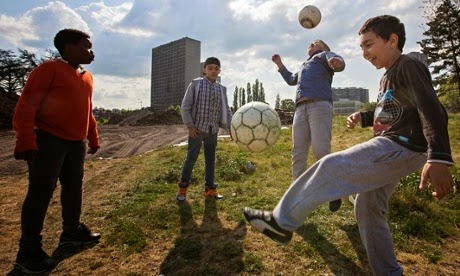
Droixhe is an area largely home to
immigrants, chronically lacking in investment, high in crime and low in
prospects – apart from when it comes to football. The gravel court where
four teenagers are tearing around in the sunshine is the same makeshift
pitch that Christian Benteke, Witsel and Zakaria Bakkali played on when
they were growing up in Liège. All three have gone on to play for
Belgium. All three also have multicultural roots, which is the case with
so many of the players whoWilmots has taken to Brazil. They are
inspirational figures to the children playing football in the streets
and help to unite what can often feel like a fragmented country.
This makeshift gravel court in Droixhe was
once home to Christian Benteke and Axel Witsel. Photograph: Graeme
Robertson for the Guardian
“It’s not easy for the kids here,” says Kismet Eris, a former
community worker in Droixhe, who runs his own football academy in Liège
and also represents Benteke. “They don’t have the same chances as the
other ones, and that’s why they’re so proud of the national team,
because now they are also accepted as Belgian people, because they see
some of their own playing for the national team. A few years ago it was
not like that. Now it is more open. With the national youth teams, you
can see that you’ve got a lot of children of immigrants, or former
refugees, representing Belgium. It’s also the country – the country is
people like Christian, [Marouane] Fellaini, Axel Witsel, [Jan]
Vertonghen, who is Flemish, Courtois, a Walloon. That’s the typical
image of Belgium.”
Belgium, as those involved in football in the
country are quick to point out, have achieved nothing yet other than
qualify for their first major tournament in 12 years and restore some
pride. Their progress, though, is indisputable and, furthermore,
everything seems to be in place to ensure they keep getting better.
Brazil may just be the start.
“It’s going to be the first time
this team is going to play in that type of environment,” says Steven
Martens, the secretary general at the Belgium FA. “Can they do that?
Absolutely they can. Will they do that? It’s very hard to say. Will they
do something remarkable over the next two, three World Cups and
European Championships? I am absolutely convinced.”
Credit: The Guardian - www.theguardian.com
Stuart James
Stuart James is a football writer who covers the midlands region for the Guardian.He is a former professional footballer
By Israel & Lemuel Lyons
With the publicly aired audio recording of the Los Angeles Clippers owner Donald Sterling’srecent comments and the banana throwing incident involving a fan at the El Madrigal stadium in Spain, racism has again raised its ugly head in sports. For those who are not aware of the details of the aforementioned incidents, here follows a brief summary. A fan threw a banana at FC Barcelona’s defender Dani Alves while he was about to take a corner kick. The day before that Barcelona game, TMZ – the Celebrity news website- released a recording of a conversation between Donald Sterling and his then girlfriend V. Stiviano during which he made negative comments about her pictures with black people on Instagram. What is so ironic is that Stivianois half black and half Hispanic!
We should not be surprised by these expressions of bigotry. Racist attitudes still exist in many quarters. Despite this, however, the public outcry and official and individual responses to these and other acts have clearly shown that racism in sport will not be tolerated and that those who practice it will be dealt with swiftly and mercilessly and in significant ways.
Sport is probably the closest thing to a meritocracy in our society all and interested parties have a social responsibility on this issue. Social responsibility is an ethical or ideological theory which holds that individuals and organizations – government or corporate have a responsibility to society. This responsibility can be “negative,” in that it is a responsibility to refrain from acting (resistance stance) or it can be “positive,” meaning there is a responsibility to act (proactive stance).
Dani Alves’ reaction to the banana thrown at him was brilliant. Without even looking at the crowd he picked up the banana, peeled it, and then ate part of it before taking the corner appearing unfazed by the racist gesture. After the game Alves tweeted as follows:
“I don’t know who threw the banana, but I’d want to thank him. It gave me energy to give 2 more crosses that ended up in goal.”
Shortly after the game a pre- planned twitter campaign became viral with pictures of football stars with bananas. Players like Neymar, Sergio Aguero, Roberto Carlos, Luis Suarez, Oscar, Willian, Marta, Mario Balotelli and even the President of Brazil showed their support for the anti racism campaign. Villareal, whose stadium was the site of the incident has issued a lifetime ban on the so called supporter who also taken into police custody.
Another example of an athlete being socially responsible is Thierry Henry. Henry, who has also experienced racism, started an anti-racism campaign along with other players to encourage solidarity among players. The campaign, known as “Stand Up, Speak Up” has gained international acceptance and support and has led to the hosting of several events and the launching of campaigns to eradicate racism. In an interview by TIME Europe, Henry stated:
“Despite their small numbers, racists influence the atmosphere and people around them by shouting over the silent majority. You probably can’t change the hard core racists, but by urging the majority to stand up and speak out against them, we can make these people feel less comfortable spouting their racism.”
Henry experienced racism not from fans but through an act from an opposing coach before a national game. He was involved in an incident in 2005 in which an obscene slur was captured by TV cameras and broadcast around the world. The Spanish national coach was trying to motivate his player by urging him to be better than “that black s_ _ t.” Henry recalled:
“I did not comment on the matter because I believed the authorities would deal with the situation.”
The authorities did not handle the situation to Henry’s liking so he agitated for the anti-racism campaign. “I felt that after all these incidents were taking place that it was the duty of a footballer to defend important values, and use their media exposure to deliver messages when the occasion presents itself,” Henry mentioned. He secured the backing of his sponsor NIKE and a group of elite players to encourage millions of fans to “Stand Up, Speak Up.” They were able to generate US$6 million dollars in funding for anti-racism groups. These players, both black and white, were present during events and advertising campaigns and participated in friendly matches to generate revenue.
“I wanted to show that racism affects all of us and that they are all banding together because they were all suffering together,” he said.
“Stand Up, Speak Up” raised money by selling nearly 5 million intertwined black and white bracelets to fans for US$2 dollars. The proceeds went to various anti-racism groups throughout Europe as well as to fan groups and youth training programs that not only teaches children techniques but also emphasizes sportsmanship. FIFA eventually ordered all its confederations and member associations to incorporate new penalties into their regulations and have threatened to exclude associations from international football for up to two years if they fail to do so.
The National Basketball Association of North America (NBA) handled the Donald Sterlingincident extremely well. The fans, players, sponsors, owners and eventually the league made strong statements condemning Sterling’s actions. They spoke with one voice: there is no place for racism in the NBA.The players’ union said that they were prepared not to participate in any playoff games if the punishment by the NBA Commissioner was not sufficient.
When asked about Sterling’s comments, Lebron James [of the NBA] said:
“If the reports are true, it's unacceptable. It's unacceptable in our league. It doesn't matter if you're white, black, Hispanic, whatever, all across the races. It's unacceptable and as a commissioner in our league, they have to make a stand, and they have to be very aggressive with it. I don't know what it's going to be, but you just can't have that in our league.”
Now that is a strong statement from the league’s marquee player
What is also of great significance is the fact sponsors such as Carmax and State Farm ended their association with the Clippers’ franchise which signals that racist actions can have financial ramifications as well. Teams might think that they can survive some negative PR for a few months but affecting their pockets is what hurts these billionaires the most. NBA Commissioner Adam Silver banned Donald Sterling from all Clippers and NBA related business for life. He will not be allowed to attend NBA games, practice or summer league games. A hefty fine of US$2.5 million was imposed on Mr. Sterling and the Commissioner promised to have a vote of the 29 other owners soon to force the Clippers into new ownership. Kudos to Commissioner Silver for taking such a firm stance!
Sport is a unifying factor. Different races, cultures, nationalities, religions may be present in one locker room or in one stadium. Let us do our part to point out racism when we see it and demand more from ourselves and those in authority whenever it raises its ugly head again.
CBS. Moore, M. “Lebron James: ‘No room’ for Sterling in NBA if comments accurate.” Cbssports.com. 26. Apr. 2014. Web. 01 May. 2014. http://www.cbssports.com/nba/eye-on-basketball/24540625/lebron-james-no-room-for-sterling-in-nba-if-comments-accurate







Recent Comment